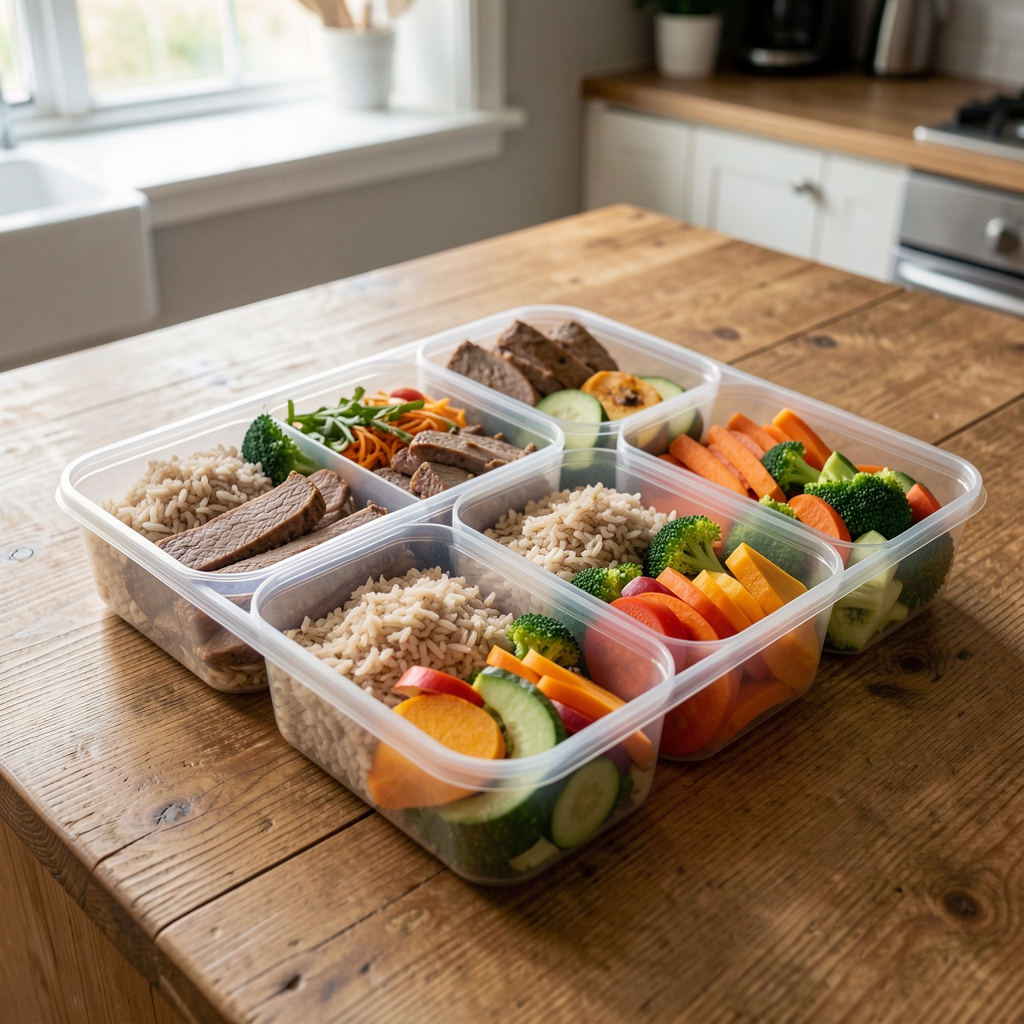
Balanced Meals

Portion sizing is among the most thoroughly researched variables in weight management literature. The evidence base across published dietary behaviour studies is consistent: visual estimation of portion sizes by adults without reference tools produces systematic underestimation of caloric content across all food categories, with the degree of underestimation scaling with energy density. Batch preparation, by externalising portion decisions to a single weekly session, removes the judgment from the point of consumption and replaces it with a pre-committed, measured standard.
Published studies on self-reported dietary intake consistently document a gap between reported and actual caloric consumption. The gap is not random — it is directional and patterned. Energy-dense foods (oils, nuts, cheese, cooked grains, protein-rich foods prepared with fat) are underestimated more severely than low-energy-density foods (raw vegetables, fruit, clear soups). This asymmetry means that the practical error compounds in the most consequential part of the diet: the calorie-dense components that determine whether daily energy balance is in surplus or deficit.
A widely cited study from the Cornell Food and Brand Lab found that adults presented with visual cues of larger portion sizes — wider bowls, larger plates — consumed measurably more calories without reporting a higher perceived volume of food eaten. The mechanism is perceptual rather than physiological: the calibration reference shifts to the container. This environmental driver of overconsumption operates independently of hunger, nutritional knowledge, or weight-management awareness.
The practical implication is not that calorie counting must be rigorous and continuous — the literature on dietary adherence consistently shows that rigid calorie-counting protocols are unsustainable in the long term for most adults. The implication is that portions should be pre-determined during the low-friction context of meal preparation, using weight-based measurements for energy-dense components, rather than estimated at the point of serving under appetite-driven conditions.
Batch preparation functions as a structural intervention: it moves portion decisions from the point of consumption — where appetite, time pressure, and convenience bias operate — to a dedicated weekly session where these pressures are absent. The decision is made once, accurately, and then executed automatically at every subsequent meal.
The architecture of an effective batch preparation session is well-documented in dietary behaviour research. A single weekly session of 60–90 minutes, producing portioned containers for 4–5 lunches and 3–4 dinners, is the format most consistently associated with adherence in working adult populations. The session typically covers three categories: a cooked grain (brown rice, whole oats, quinoa, wholemeal pasta), a protein source (legumes, eggs, fish, or white meat), and a prepared vegetable component that can be combined in varying configurations to prevent monotony.
| Component | Reference Portion (cooked weight) | Approx. Calorie Range |
|---|---|---|
| Cooked brown rice | 180–200 g | 230–260 kcal |
| Cooked lentils / chickpeas | 150–180 g | 175–215 kcal |
| Roasted mixed vegetables | 200–250 g | 80–160 kcal |
| Baked salmon fillet | 120–140 g | 240–285 kcal |
| Olive oil (per serving) | 10–12 g (1 tbsp) | 88–106 kcal |
The oil row in the table above is included deliberately: it is consistently the most underestimated component in home cooking, with survey data showing adults estimating 6–7 ml while pouring what is measured at 18–22 ml. A single tablespoon measured by weight at the preparation stage versus poured by estimation at the cooking stage represents a 90–110 kcal variance per meal — cumulatively significant across five meals weekly.
"Portion sizing is most accurately handled at the preparation stage, where appetite-driven perception is absent and measurement tools are accessible without friction."
Eleanor Whitfield — Braloven Compendium, March 2026
The dietary behaviour literature draws a consistent distinction between calorie awareness and calorie obsession. The former — a working knowledge of the approximate energy density of standard food categories and an ability to construct meals within a broad target range — is associated with better dietary adherence and more stable body composition in long-term cohort studies. The latter — rigid point-by-point calorie accounting at every meal — is associated with elevated dietary restraint scores and higher rates of binge-compensate cycling in the same literature.
Calorie awareness in practice means knowing that the grain quarter of a plate contributes approximately 200–280 kcal from cooked whole grains, the protein quarter 200–300 kcal depending on source, and the vegetable half 60–180 kcal depending on preparation method. The total assembled plate sits in a range of 460–760 kcal — a range that allows sensible calibration without requiring gram-level precision at every meal.
The sustainable weight approach referenced in the publication's editorial scope is based on this moderate-awareness model: a plate structure with documented compositional and portion logic, applied consistently, produces gradual energy balance without the psychological overhead of rigid calorie accounting. Published trials comparing ad libitum consumption of structured-plate diets against calorie-restricted diets consistently show comparable outcomes at six and twelve months, with higher dropout rates in the calorie-restricted group.
The Cornell research cited above translates directly into a preparation equipment recommendation: containers used for batch-prepared meals should be consistent in size, with a capacity that reflects the target portion rather than the maximum the container holds. A 700 ml container filled to a standard portioned level provides the same visual cue as a 1,000 ml container filled to the same volume — but the former is perceived as adequate and the latter as incomplete, producing a consistent pull toward topping up.
Separate containers for grain, protein, and vegetable components — assembled at the meal rather than pre-combined — offer additional flexibility: individual portions can be adjusted based on the day's activity level without requiring a new batch preparation session. A more active day warrants a larger grain portion; a sedentary day warrants a smaller one. The protein and vegetable components remain constant. This modular architecture is more responsive than a pre-combined fixed meal while retaining the preparation-stage portion decision.
Plate diameter is a parallel variable: the published consensus from environmental nutrition research recommends 22–24 cm diameter plates for standard adult portion presentation — significantly smaller than the 28–32 cm dinner plates that have become standard in UK and US household inventories. The visual satiety cue from a proportionately filled smaller plate is functionally equivalent, in published perception studies, to that of a proportionately filled larger plate, despite a 25–30% difference in actual food volume.
The dietary behaviour literature consistently identifies food journalling as a positive predictor of dietary adherence and weight management outcomes. The effect size is moderate but robust across demographic groups and intervention formats. The mechanism is not primarily cognitive — it is not that journalling provides information that changes rational decision-making. It is predominantly attentional: the act of recording a food intake event increases the salience of that event, which in turn moderates subsequent choices through a well-documented attention-to-norm mechanism.
For the batch preparation context, a minimal journalling protocol is sufficient to capture the benefit without producing the burden associated with rigid calorie accounting. Recording the three meal categories (grain, protein, vegetable) and approximate portion by weight for each batch session — once per week — produces the baseline data needed to assess whether the week's nutritional targets were broadly met and to adjust the following week's preparation accordingly.
The weekly grocery planning cycle is naturally integrated with this journalling practice: a 10–15 minute session on Sunday that covers the previous week's preparation assessment and the following week's menu and shopping list captures the planning and recording functions simultaneously. Published behaviour research on habit stacking — the attachment of a new behaviour to an existing anchor activity — suggests this bundled Sunday session is among the most structurally stable formats for maintaining meal preparation habits over extended periods.

Eleanor Whitfield is the lead editor of Braloven Compendium, with a background in nutritional science communication and a focus on evidence-based everyday eating patterns. Her writing draws on peer-reviewed dietary research and published compositional databases.
More from this author →